

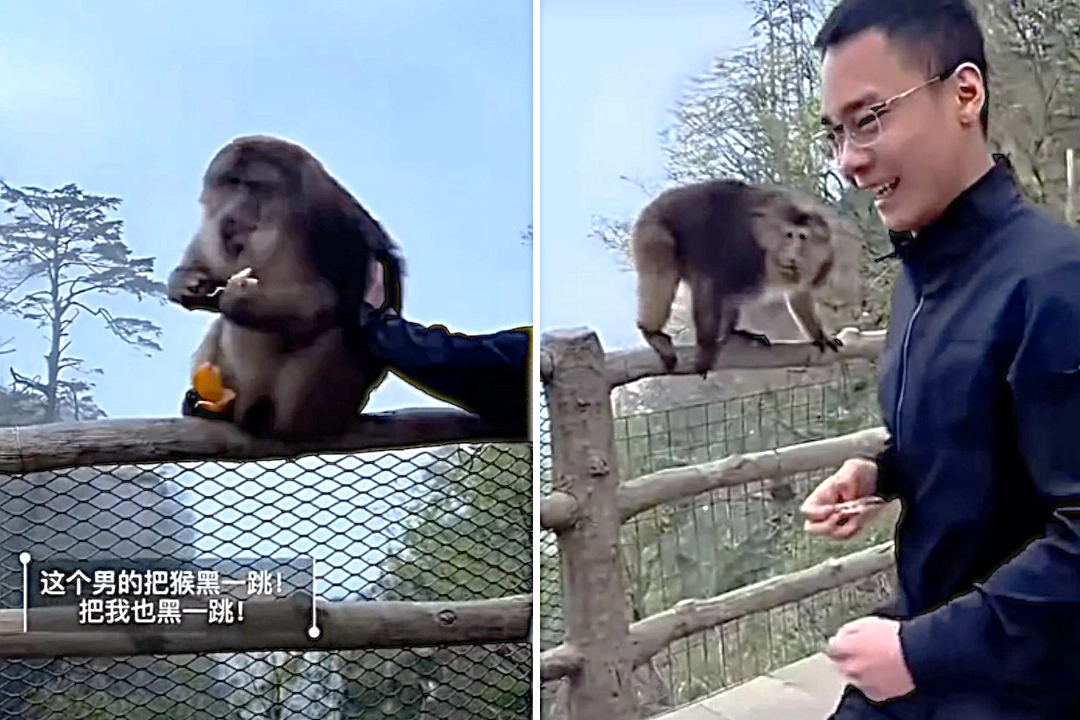

The monkey was eating an orange.
Sitting on a guardrail, minding its business, at one of China’s most sacred scenic sites.
Then a tourist walked over and tried to shove it off the edge with both hands.
The animal teetered, caught itself, then lunged at the man in fury.
He ran away laughing.
What happened at Mount Emei
The incident took place on Monday (4 May) at the Mount Emei Scenic Area in Sichuan Province — a UNESCO World Heritage Site and home to around 500 Tibetan macaques across fifteen resident groups.
The animals are classified as a second-class nationally protected species in China.
The site’s rules explicitly prohibit tourists from feeding, teasing, startling, or touching them.
The footage spread quickly. Onlookers can be heard gasping as the monkey teeters on the rail before recovering its balance.
The tourist’s reaction — running off, laughing — did not help public sentiment.
“This is not a joke; it is disregard for life,” one commenter wrote.
Another said: “I rarely stand on the monkey’s side, but this time I stand on the monkey’s side.”
A third added: “The monkey’s life is also a life — injuring a nationally protected animal should have consequences.”
Identified, apologised, blacklisted
On Wednesday (7 May), the Emei Mountain Scenic Area Management Committee issued an official bulletin confirming the man had been identified.
He reportedly admitted what he had done and apologised.
He has since been added to China’s uncivilised tourist blacklist and is banned from the site for three years.
Local lawyer Guo Gang outlined what could have followed had the outcome been worse.
Under China’s Wild Animal Protection Law, had the monkey fallen and died, the tourist would have faced an administrative fine of between £1,080 and £10,800, with possible criminal charges on top.
The only scenario where no liability would apply, Guo said, is if the animal had attacked first in a way that endangered human safety.
It hadn’t. It was eating an orange.
Why it matters
Wildlife harassment at tourist sites is a persistent problem, and China’s blacklist system — which can bar individuals from transport networks, hotels, and public spaces as well as specific venues — is one of the more direct tools any government has deployed against it.
Whether a three-year ban registers as a serious deterrent is another question.
The monkey, for what it’s worth, appeared uninjured. It lunged. The man ran.
On the available evidence, it handled the situation better than he did.
READ MORE: I lifted the toilet seat during an emergency – my cat was sitting inside like a porcelain GOBLIN