
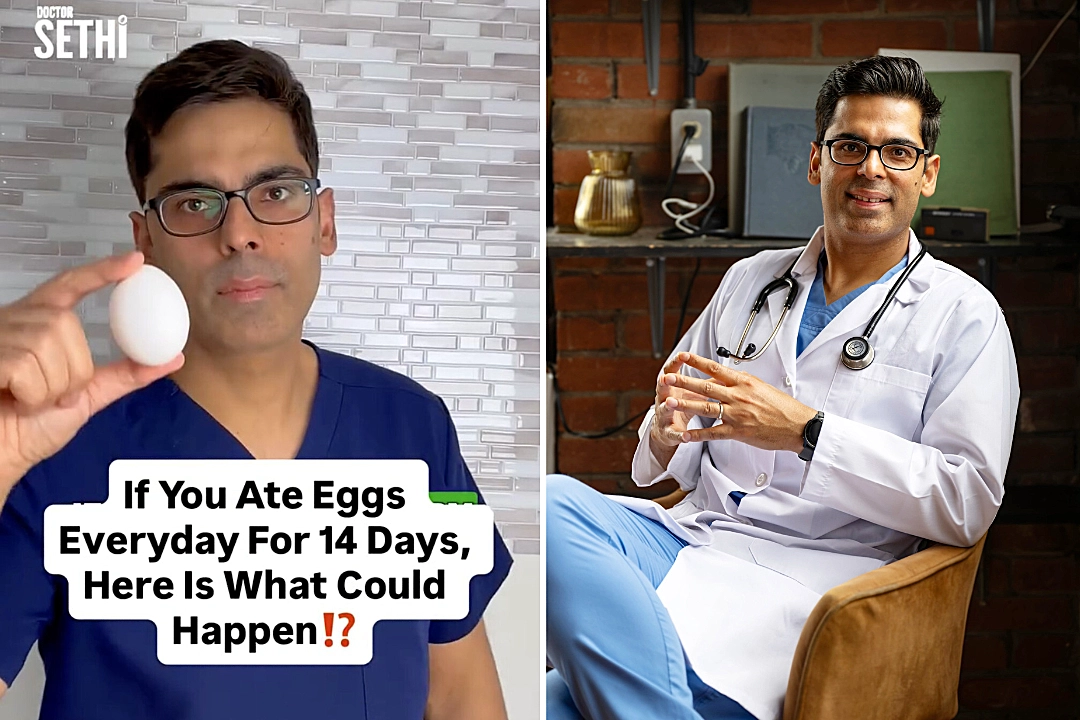

A Harvard-trained doctor with 1.5 million Instagram followers has laid out exactly what happens to your body when you eat eggs every day for two weeks.
The answer covers more ground than most people expect.
Dr Saurabh Sethi, 43, a gastroenterologist based in California, broke down the effects in a clip that has since pulled in 747,000 views and over 12,000 likes.
The findings span four body systems.
Start with the eyes. Egg yolks contain lutein and zeaxanthin — antioxidants that filter high-energy blue light and support long-term eye health.

With blue light exposure now higher than ever — one study by Poudre Valley Eyecare found people working from home experience up to 25% more digital eye strain than office workers — the dietary buffer matters more than it once did.
Prolonged blue light exposure has been linked to disrupted sleep and contributes to age-related macular degeneration.
“Your eyes will get protective nutrients,” Dr Sethi said.
“Egg yolks contain lutein and zeaxanthin, which are the antioxidants that help filter high-energy blue light and support eye health.”
The brain benefits too. Eggs are rich in choline, which the body uses to produce acetylcholine — a neurotransmitter directly involved in memory and focus.
It’s one of the more under-discussed nutrients in mainstream diet conversation, and eggs are one of the most accessible sources of it.
Hair, skin and nails come next.
Eggs provide sulfur-containing amino acids that support keratin production — the structural protein those three things are largely built from.
Then cholesterol, which is where eggs have historically taken the most criticism.
Dr Sethi’s position is more measured than the old headlines.
“In many people, eggs can actually increase HDL — the good cholesterol,” he said.
The relationship between dietary cholesterol and cardiovascular risk is more complex than the blanket warnings of previous decades suggested, and the current evidence is considerably more favourable to eggs than it once was.
What if you don’t eat eggs?
Dr Sethi addresses this directly. For vegans, soy-based foods — tofu, tempeh, edamame — offer the closest plant-based protein equivalent.
The benefits, he says, can be accessed through those alternatives.
Why it matters
Dr Sethi’s content sits in a crowded space — medical professionals on social media is its own genre now — but his framing is worth noting.

Rather than a list of superfoods or a supplement stack, he’s making the case for one of the cheapest, most widely available foods on a supermarket shelf.
At a time when functional nutrition content is increasingly tied to expensive products and branded protocols, a Harvard-trained doctor telling 1.5 million followers to eat eggs is a refreshingly straightforward message.
For health and wellness creators, the clip is also a useful reminder that the highest-performing content in this space tends to be specific, time-bound, and immediately actionable.
Two weeks. One food. Four outcomes. 747,000 views.
What’s next
Dr Sethi continues to build one of the more credible medical voices on Instagram.
Whether eggs maintain their current rehabilitation in mainstream nutrition discourse — after decades of cholesterol scaremongering — is the longer conversation his content is quietly contributing to.